Monday, October 5, 2020

Illness Narrative#2: Cultural Narratives of COVID-19


DUE OCTOBER 21 (midnight)

For this second essay,,you are to collect  illness narratives from social media which express a range of beliefs and reactions to the pandemic. 

  • Your narratives are to be presented as other "voices". 
  • Your narratives should be grouped according to cultural themes which you create.
  • The cultural themes will be representative of a "sub-culture"
  • Your subculture will be identified by their own "language" (terms and ways of speaking (arguing, making a point, expressing ideas).
  • Your narrative should end with a summary analysis of the data that you have presented.
The final part of the essay should be the only place where your voice is heard. 
Your themes should present different voices that are illustrations of that theme (for example: It's a Hoax (virus deniers), Apocalyptic, QANON (Conspiracy), etc. ---you make them).

This is good practice for ethnographic reporting since your "voices" are all that will illustrate your "themes" (conclusions/analysis). 

5-10 pages (guess, since your "dialogues" will be a significant part of the paper)

Since you will be looking at others words and dividing your informants into themed "subcultures" Let's look at The way language and culture are connected when looking at illness narratives:

Fieldworkers (anthropologists) look to both verbal and nonverbal language to understand rules and meanings  (examples of recorded narratives you can watch later from the oral history project).


Why study verbal language?
  • verbal language brings nonverbal thoughts and ideas to the surface
  • language can become the focal point of your research
  • informants "voices" are most clearly transmitted through their verbal communication
What do systems of communication reveal?
  • solidarity and exclusion markers
  • aspects unique to culture (jargon)
  • symbolic systems within a culture
  • the relationship between language and culture
Nonverbal Communication: Body Language and Culture (if you have visuals)
  • proxemics-use of and meaning of space
  • kinesics-meaning of body movement and gesture
  • microsignals-gaze (etc.) -unconsciouss small signals
  • touch-meaning and use
  • dress and adornments-meaning of chosen displayed symbols of identity
    • tatoos
    • dress
    • hair
    • piercings
    • teeth
    • makeup
    • plastic surgery or other bodily "mutilations"
Linking Words and Culture
  • look for key words, phrases and ideas that serve as clues into informant's culture
  • think of every "artifact" of a culture like a" sponge" and ask what you can squeeze out of a concept.
  • remember that language changes over time and even within a specific context
  • memes are examples of deliberate cultural information (why is a meme culture bound?)
  • where we find cultural differences, we will find language differences
    • example: meditation on the word "cheek" (19th century)
    • creating a "glossary" of terms or words with specific meanings
Using Insider Language in Your Writing
    • integrating the language of the subculture into your account in your descriptions
    • using significant terms to theme your illness narratives
      • words as cultural artifacts
        • emphasis on terms means the "thing" they are describing is important in culture and demands further investigation
          • different words for "silk" in China, or "snow" in the Arctic
      • context in which words are used (rules for performance)
        • example: the word "whore"
    During the 2018 Miss’d America Pageant dress rehearsal, as each contestant was introduced and came to the microphone out of drag to say something about themselves, HRH Mortimer yelled from the seats, “Whore!!!” When asked later about the purpose of this “reading,” HRH Mortimer explained:
    “I say “whore” because I want to throw them off their game…like someone in the audience is like, “Ohhh…you whore!” And they find out later it’s me, saying, “I see you.” I make sure to say it with every one that came out. To me “whore” is not an insult, it’s a compliment. It’s like recognizing you exist…hey, I see you up there on that runway…I’m here with you. It’s real.”
    • example the word "read"
    Language ideologies in gay and drag communication and ways of speaking are important products and practices developed and shared in the drag community in Atlantic City. Local queens learned how to perform drag together as they all worked the same vibrant bar scene; to make costumes, put on productions, and paint their faces. They developed a particular way of communicating with each other, sharing a vocabulary and style of communication, a camp style of speaking that signaled their identity as local drag queens. Communication was based on competition, and humor was based on a kind of reading of those performances. Reading can be described as a sometimes-scathing critique of someone’s appearance, lack of talent, intelligence, hygiene, or most of all, sexual behavior. Reading is one of the many aspects of communicative interaction that indexes gayness, and as Rusty Barrett beautifully illustrates in his research, “gay male subcultures are crucially constituted through language.” Reading is a communicative strategy that is learned as part of the evolution of one’s identity as a gay man. Miss’d America 2015, Fifi Dubois, talks about how she sees “drag language”:
    “It’s fun…its campy…Its gay culture. I think it gives us our own dialect, our own language that people can use. It’s a way to identify other gay people. Or other drag queens…through how we talk.”
     Gay Language (e.g. sentimental voice, emphatic stress, diminutive affix, marked vocabulary), and stylistic forms like reading and camp in general, serve to index gay identity and gay culture. Indexicality is critical to understanding forms of camp, (discussed further in the section below), and is “central to monitoring questions of sexual identity such as “gaydar.” Much of gay language establishes identity through forms of indexical disjuncture. Indexical disjuncture uses indexical signs (aspects of communication) that are marked. That is, they are counter to normative expectations of the relationship between form and context. Drag queening is an obvious form of disjuncture, and so are the mocking and insulting characteristics of reading, since their intention is to be properly read as neither mocking nor insulting. This is one reason why drag queens often find it curious that feminists critique their presentations as misogynistic. The disjuncture, although referencing normativity, has little to do in their minds with its uncritical acceptance. As Josh Rivers noted “drag queens all over the world are engaged in the quotidian negotiation of boundaries between what Michael Lambek terms the “continuous person,” their “boy selves,” and the “discontinuous act of performing” their drag personas.” Reading is a recognition of this negotiation, which is how drag identity is properly werked. It is a recognition of the fluid (rather than distinct) boundaries between their boy and drag selves. As Evelyn Syde described:
    “…[I]t’s not just insulting someone. A good read is well thought out, educated, creative and clever, but in person… well, reading does come from the AIDS crisis and the terror that everyone was going through, and it was a way for people to find humor in a desperate situation, so… reading and shade are friendly reminders to not take this so seriously, ourselves. At the end of the day we are men in dresses. This is not necessarily a living; we are doing it out of love for the most part. [It] is a reminder to humble yourself, and to remember that at the end of the day you are going to go home to your cats.”
    The sentiment that reading acts as recognition of fallibility is meant to remind queens not to take themselves too seriously, but it is not meant to be hurtful. One reads themselves and people they care about.
    • example of the word "camp"
    Although camp is not exclusive to gay communication and presentation, interpretations of camp are, according to Barrett, deeply dependent on the normative citations within LGBT communities, comprising a folk wisdom in gay male culture. From this perspective, gay men learn a set of “essential aesthetic judgments for the evaluation of camp” that play an important role in the “social construction of (gay male) identity.” Drag, unlike transvestism, is premised on theatrical structure and style. “There is no drag without an actor and his audience, and there is no drag without drama (or theatricality).” Men who become drag queens have come out in and been socialized in the homosexual community first. He is already a gay man and must come out again as a drag queen. The drag queen, like camp, flaunts her homosexuality on stage, without any apology. As Newton notes in her classic study of drag queens in New York City, drag is inherently expressive of gayness:
    “…drag symbolizes gayness. The drag queen symbolizes an open declaration, even celebration, of homosexual. The drag queen says for his gay audience, who cannot say it, “I’m gay, I don’t care who knows it, the straight world be damned.”
    As Morgan Wells, Miss’d America 1999 and owner of Morgan Wells’ Drag Closet explains:
    “Yaaaas it’s campy! And girl you know it should be. You got to have something to laugh about. And why not? When your friends are all sick and dying and then people are saying it’s your fault. When what you supposed to act like is really the drag. The world is already ironic, funny, ridiculous. It’s just that some of us can see it, you know…and some of us can’t. You ain’t a drag queen, NO, you probably ain’t GAY unless you can!”
    The ability to see the ironic, funny, and ridiculous nature of the world at any moment is illustrative of this folk wisdom and gay ideological perspective that also includes assumptions about gay male superiority in areas of taste and style. Shared as well, are values about self-presentation, like the necessity for passing in certain contexts, and the ironic, sometimes parodical nature of these quotidian public presentations of self. Gay men must become versed in this folk wisdom and the language ideologies underlying gay camp communicative interaction in order to be successful in gay culture, since fluency in these gains access to gay subculture and protection from the often hostile heterosexual world.

    • Ethnopoetic notation: allows you to preserve the diction, pacing and emphasis of language (if you can hear someone speak-verbal language, tik-tok, utube, etc).
      • rhythms
      • repetitions, 
      • tensions
      • insights
      • cultural meanings
    • Insider Language: How to Do the Research
      • goal is to analyze language from the perspective of your informants
      • occupational language
      • cursing
      • other special genres of talk (like reading, above).
      • jokes,joking behavior
      • proverbial speech
      • spiritual/other performance
      • urban legends
        • contain within them important cultural values, beliefs and ideals
      • lack of talk
    SUMMARY: Language and Culture are Intimately Linked

    Wednesday, September 30, 2020

    Example: Vital Energy System -Ayurveda

     THE BODY AND THE NADIS

    Nadis are pathways of pranic, mental and spiritual currents which form a matrix throughout the physical body. They provide energy through every cell, and organ through their vast network. Nadis are not physical or measurable but channels of energy which underly and sustain life and consciousness. Out of the 72,000 nadis, 72 are considered important. Out of these 72, 10 are considered to be major. Among the 10 major pranic flows, three are the most significant. (Situated in the spinal column which pass through every chakra.)
    • Eda (Mental channel = female; Chandra = lunar/moon nadi) 
    • Pingala (Vital channel = male; Surya = sun/solar nadi)
    • Sushumna (Spiritual channel) 
    The 7 lesser major nadis include:
    • Gandhari 
    • Hastijihva
    • Yashaswini
    • Pusha
    • Alambusha
    • Kuhu
    • Shankhini
    The three most important nadis are also referred to as the 3 most important rivers in India:
    • Ganga (Eda) 
    • Yamuna (Pingala)
    • Saraswati (Sushumna) 
    The junction where these three rivers join is called Prayag, located outside Allahabad in North India. In the pranic body, they converge at ajna chakra. 
    • Eda governs the left side of the body and Pingala the right side of the body. 
    • Eda and Pingala dominance is directly related to the flow of breath in the nostrils. 
    • The specific functions of the brain are correlate with the activities of Eda and Pingala. The right hemisphere governs the left side of the body and the left hemisphere governs the right side of the body. Eda is connected to the right hemisphere and Eda to the left. 
    • The right hemisphere (Eda) processes information in a diffuse and holistic manner. It controls spacial awareness and is sensitive to vibrations and the external senses. 
    • The left hemisphere which relates to Pingala processes information in a sequential, linear and logical manner. It is responsible for analytical and mathematical ability. 
    • The Eda controls manomaya and vijnanamaya koshas, whereas pingala controls anamaya and anandamaya koshas. In pranamayakosha, the Eda and Pingala forces reach out in both directions. 
    • Sushumna, the neutral channel- when the two forces of Eda and Pingala are balanced, the third channel of Sushumna becomes active. When the sushumna is active, the breath flows through both nostrils simultaneously. 
    Ayurveda is a 5,000-year-old system of natural healing that has its origins in the Vedic culture of India. It is one of the seven sister sciences (along with yoga). Although suppressed during years of foreign occupation and British colonial rule, Ayurveda has been enjoying a major resurgence in both its native land and throughout the world. Tibetan medicine and Traditional Chinese Medicine both have their roots in Ayurveda. Early Greek medicine also embraced many concepts originally described in the classical ayurvedic medical texts dating back thousands of years.

    More than a mere system of treating illness, Ayurveda is a science of life (Ayur = life,Veda = science or knowledge). 


    • It offers a body of wisdom designed to help people stay vital while realizing their full human potential. 
    • Providing guidelines on ideal daily and seasonal routines, 
    • diet, 
    • behavior and 
    • the proper use of our senses
    Ayurveda reminds us that health is the balanced and dynamic integration between our environment, body, mind, and spirit. There is no standard therapy as in Western (allopathic) medicine, so that the only limitations are those of the physician.

    Recognizing that human beings are part of nature, Ayurveda describes three fundamental energies that govern our inner and outer environments: movement, transformation, and structure. Known in Sanskrit as:
    •  Vata (Wind), 
    •  Pitta (Fire), and
    •  Kapha (Earth)
    these primary forces are responsible for the characteristics of our mind and body. Each of us has a unique proportion of these three forces that shapes our "constitution" (nature).
    • If Vata is dominant in our system, we tend to be thin, light, enthusiastic, energetic, and changeable. 
    • If Pitta predominates in our nature, we tend to be intense, intelligent, and goal-oriented and we have a strong appetite for life. 
    • When Kapha prevails, we tend to be easy-going, methodical, and nurturing. 

    Although each of us has all three forces, most people have one or two elements that predominate.

    For each element, there is a balanced and imbalance expression. 

    • When Vata is balanced, a person is lively and creative, but when there is too much movement in the system, a person tends to experience anxiety, insomnia, dry skin, constipation, and difficulty focusing. 
    • When Pitta is functioning in a balanced manner, a person is warm, friendly, disciplined, a good leader, and a good speaker. When Pitta is out of balance, a person tends to be compulsive and irritable and may suffer from indigestion or an inflammatory condition.
    •  When Kapha is balanced, a person is sweet, supportive, and stable but when Kapha is out of balance, a person may experience sluggishness, weight gain, and sinus congestion.
    An important goal of Ayurveda is to identify a person’s ideal state of balance, determine where they are out of balance, and offer interventions using diet, herbs, aromatherapy, massage treatments, music, and meditation to reestablish balance.

    Ayurveda: the science of health PP 


    __________________________________________


    Ayurvedic Cleanse (you could try this!)
    Ayurveda (Sanskrit for “the science of the lifespan”) is a 5,000-year-old system of natural healing that has its origins in the Vedic culture of India. This Ayurvedic cleanse and diet will reset the body in balance!
    Adapted from Melissa Weinberger DC, RN

    Daily Cleansing Routine
    *Starred points are to be followed only during the cleanse. All other points should be followed during the pre-cleanse, cleanse and post-cleanse
    ·         Begin each morning by drinking 6-8 oz of hot water
    ·         *Optional: drink ghee (see instructions below)
    ·         Abhyanga: Ayurvedic Massage
    Before bathing, rub a thin layer of warmed or room temperature oil (unrefined sesame or coconut) over entire body. Use long strokes for your limbs and circular strokes for your joints. Ideally, let the oil sink in for 20 minutes before showering.
    Since sesame and coconut oil are natural skin cleansers it is best to not wash the oil off with soap; the hot water will wash most of the oil off. Then pat dry with a towel. (1 teaspoon of baking soda in the wash will help to remove oil from towels)
    ·         Exercise before breakfast (if this is not possible you can exercise in the early evening)
    ·         *Breakfast – prepare porridge or kitchari (see recipe below)
    ·         Sip hot water throughout the day
    ·         *Kitchari for lunch and dinner
    ·         Supper should be the lightest meal of the day and preferably eaten before 6 pm
    ·         Drink only herbal tea and honey or water after supper
    ·         Try to avoid snacking between meals. If you feel hypoglycemic, try drinking 8 oz. of water first. If you still feel hungry, have a snack of veggies, berries or kitchari.
    ·         The purpose of the cleanse is to eliminate all processed foods from your diet and give your digestive tract a break.
    ·         However, make sure you are eating enough food that you aren’t starving. Once you feel starving, your body moves from a relaxed state to a stressed state.
    ·         Optional: 2 Triphala capsules before bed. This is an Ayurvedic blend of herbs that assist with detoxification and rejuvenation.
    ·         Take time for self-reflection. Emotions are stored in fat cells, so as fat cells are being metabolized emotions may surface that need to be processed.
    Pre & Post-Cleanse Instructions
    ·         The pre- and post-cleanse will last three days
    ·         Eat a low-fat vegetarian diet of fruits, vegetables, beans, rice, salads, seeds and soup.
    ·         Eat as many steamed and raw vegetables as possible
    ·         Add seeds, lean chicken and egg whites for protein
    ·         Avoid nuts, unless they are prepared properly
    ·         1 grated raw beet with lemon juice per day is a good addition because it helps to thin the bile and emulsify fat
    ·         Do not add any sugar, oils, wheat or dairy to the diet
    ·         Salad dressings should be low in fat but preferably homemade
    ·         Try to eat three meals a day without snacking
    ·         Continue the daily routine of sipping hot water in the morning, followed by abhyanga, shower and exercise.
    Meal Options for Main Cleanse
    ·         Kitchari Only (requires strong digestion and balanced blood sugar) – can eat 4 meals/a day if necessary with this option
    ·         Kitchari with steamed veggies (requires strong digestion and fairly balanced blood sugar)
    ·         Kitchari, steamed veggies, fruit and salad (Better for weaker digestion and fairly balanced blood sugar)
    ·         Kitchari, steamed veggies, fruit, salad and lean protein (best for weak digestion and blood sugar issues)
    Morning Ghee Protocol & Castor Oil Protocol
    **this is optional, depending on how intense you want your cleanse to be**
    ·         Upon waking (on an empty stomach) drink the prescribed amount of melted ghee (clarified butter). You can mix it with warm almond milk to make it more palatable.
    ·         Wait a half hour before drinking or eating anything else so ghee has time to collect toxins.
    o   Day One: 2 tsp ghee
    o   Day Two: 4 tsp ghee
    o   Day Three: 6 tsp ghee
    o   Day Four: 8 tsp ghee
    §  Only increase the dosage if you are tolerating it
    Laxative Therapy – do not skip this step
    ·         On the evening of day 4 take a warm bath followed by ingesting 4-6 teaspoons of castor oil OR 1 ½ cups of prune juice
    o   Castor Oil Tip: cut an orange into slices. Put castor oil in ½ cup warm water. Mix the juice from one orange into castor oil and stir vigorously. Hold your nostrils, drink the mixture and immediately bite into a slice of orange. Rinse cup, release nostrils.
    ·         You should have a laxative effect from 1-15 hours. It is ok if you don’t have one.


    Suggested Meal: Kitchari (Rice and Lentils)
    Makes about ten ½ cup servings
    Ingredients
    ·         1 cup organic White or Brown basmati rice (you can mix them)
    ·         1 cup organic Mung Dal (yellow lentils)
    ·         4 cups water
    ·         2 tablespoons organic ghee
    ·         2 tablespoons minced fresh ginger OR 1 tablespoon dry ginger
    ·         1 ½ tablespoons cumin powder
    ·         1 tablespoon Cumin seeds, fennel seeds, mustard seeds, coriander
    ·         1 teaspoon turmeric
    ·         Salt and pepper to taste
    Optional Garnish
    ·         Chopped cilantro, Greek yogurt, Sour Cream or Ghee
    Directions
    Bring water to a boil in a large, heavy-bottomed saucepan. Put rice and dal in a fine mesh colander and rinse mixture under cool water until it runs clear. Pick over rice and dal to remove any stones. Add rice and dal to boiling water. Cover and lower heat to a simmer and cook about 30 minutes or until the water has been absorbed (add more water if you prefer a soupier consistency).
    Sauté spices in ghee or butter in sauté pan until fragrant, then remove seeds. When rice is finished cooking, remove from heat. Pour ghee-spice mixture into rice and stir together thoroughly. Serve with chopped cilantro and a dollop of yogurt or sour cream.
    Variations
    ·         Add roughly diced spinach, carrots, zucchini, green onion and bell peppers to the boiling water when you add the rice and dal. Add a few tablespoons of lemon juice when finished.
    ·         Use a low sodium chicken or vegetable broth instead of water
    ·         Add diced sweet potatoes and asparagus to boiling water when adding rice.
    ·         Add cubed, cooked chicken breast to rice when finished.
    ·         For a sweet version: add ½ cup low fat organic coconut milk, maple syrup to taste, and cinnamon and nutmeg to ghee. Omit the cumin and turmeric.

    Sunday, September 27, 2020

    Medical Systems and Vital Energy

     VITAL FORCES:

    Throughout various cultures the concept of substances which ebb and flow as a consequence of life forces are described and managed to maximize the health and well-being of communities and individuals. These competing forces necessarily interact in the human body (microcosm) and in the universe (macrocosm)
    • Ndembu (Turner): describes three forces
      • white rivers (milk & semen)
      • red rivers (blood and loss of blood-particularly menstruation)
      • black rivers (death, waste, decay)
    • Flow, Fluidity and Flux are important processes for health & healing in African cultures, Papua New Guinea, India, China and ancient Greece.
      • based on the belief that the flow of substances in the natural environment and the human body is needed for survival, wellness and healing.
      •  Harm comes from the stoppage of this flow or "flooding"
      • path to longevity is the MIDDLE WAY
      • modern medicine : "homeostasis" (state of internal balance attained by living things regulating their physiological processes-sweating on a hot day, restricting capillaries when it is cold)
    • HUMORS (vital fluids that a culture recognizes are fundamental aspects of life)
      • must be kept in balance (often by consuming certain foods and liquids)
      • notions of hot/cold/cool are key to understanding humoral activity-as are Wet/Dry
      • activities, weather changes, emotions all can deplete or restore vital fluids
        • MELPA (png): 2 humors (blood & grease)-form two separate but interconnected sources of vitality which must flow freely and be exchanged appropriately for health & harmony to be maintained.
          • can be depleted in people and communities
            • a man uses up his grease through intercourse, a woman through regnancy and breastfeeding-must be replenished by consuming pork fat and juicy vegetables
            • optimal conditions for health are found in balancing the "hot" and "cold" in "cool" (fair minded-cool- actions of a chief provide grease for the community, eg)
            • pigs are exchanged between families to restore group harmony
      • The flow of drinks, food, gifts and commodities and the essential and complex functions of these circulations establish and maintain strong social bonds in all cultures and societies.
        • KULA RING (ti)
        • MAWRI (Niger): the health of a market depends on the the presence of "spirits" who protect it and animate it by their presence. The flow of material and spiritual gives RAI (life) to the market.
        • INTERNET (markets) need "traffic" to be healthy in this same way.
    • INFORMATION TRANSMISSION:
      • in small scale, mostly oral societies, information was transmitted traditionally for elders and ritual specialists to their apprentices. This mostly took the form of valuable CULTURAL KNOWLEDGE and ENVIRONMENTAL KNOWLEDGE.
      • these traditional flows of information have been supplanted by formally trained professionals, mass media, and the internet in modern times
      • instead of learning from their mothers and grandmothers, women are turning to lactation specialists, books, websites etc in order to gather information about breastfeeding and childcare (ie)
      • RUMORS:
        • The developing world, health and illness
          • subject to rumors which reflect the INEQUALITY of access to QOL.
            • high quality, high tech medicine is unaffordable and a tightly guarded resource accessible only to the rich (small portion of the population)
            • the world in which poor people live is composed of alternative opportunities and risks which they are unable to control-why RUMORS are so powerful (reflects the feelings of COMMODIFICATION OF THE BODY)
              • organ stealing (all over)
              • kidnapping (Guatemala)
              • poisoning with vaccines
              • commodification of the body of the poor for the rich through western medicine (can the POOR really be said to "donate"?)
                • organ transplantation (DONATION)
                  • there is a global shortage in all human tissues and a "wait list"
                    • cultural construction created because of a number of factors including denial of death, biotechnological progress and social inequality
                  • poor people are fearful that their death will be hastened or provoked (flow of organs goes from poor to wealthy transnationally-Nancy Scheper-Hughes & margaret Lock)
                  • see themselves as a collection of spare parts
                • stem cells (LACKS cells)
                • surrogate mothers
                • adoption
                • fertility
                  • donated egg/sperm
                • research subjects as human guinea pigs
                • blood banks (DONATION?)
                  • a woman donating twice a week in central Mexico may earn more than her husband
                • hair (Hindu pilgrims to the Tirumala temple in Andhra Pradesh donate their hair to Vankateswara-sold for millions of dollars annually for hair weaves in the West)-REMY HAIR
    WATER: VITALITY & CONTAMINATION
    • Bodies of water (Nile, Euphrates, Ganes & Jordon Rivers) are considered SACRED
      • purification by babtism (Christian)
      • holy well visitations in Ireland (cures a variety of illnesses including headaches, abdominal pain, warts, whooping cough, sore throats & eye problems).
    • Water can be used for HEALING and RITUAL PURIFICATION in many cultures
      • Hippocrates: baths for healin
      • Judaism: Mikvah for purification
      • Public Mineral baths : japan, Rome, Turkey-important part of social and cultural life
      • Rainmaking rituals : Egypt, Native Americans, Rural Romania (Parapuda)
    • Water is a great FORCE OF NATURE (may be unpredictable & uncontrollable)
      • floods, storms, drowning, sunami
      • contamination and carrier of disease (typhus, yellow fever, parasites, environmental toxins & bacteria)
      • modern fact: shortage of clean drinking water
      • Apache: White Painted Woman-culture hero emerges from water
      • women are often associated with water and cycles of the moon that are connected to the movement of tides and cycles of fertility. 
        • female water spirits are the source of danger and disease in many cultures-particularly for men (Mermaids)
        • MAMI WATA: female serpent deity found throughout the African diaspora-giver of prosperity beautiful but also life-threatening
    • Water in HUMORAL SYSTEMS
      • commonly seen as an element in wet/dry dyad that needs to remain balanced
        • Chinese medicine
          • associated with the yin/yang principle
            • YIN: contractive, centripedal, responsive, positive, cold, wet, female)
            • YANG: expansive, centrifugal, demanding, negative, hot, dry, male)
            • health: life force (qi/ki/chi) must be allowed to flow unimpeded or restored through various therapeutic methods, especially foods and herbs, but also acupuncture. 
            • yin and yang are integrated. they contain a seed of eachother, and the whole is essentiial
    • Feng Shui: Spaces and interiors can also be imbalanced and effect health. Uses colors and objects along with laying out interiors according to the cardinal directions to create greater harmony, health and prosperity).
      • the human being is an integral part of nature and subject to the same natural laws
    • Ayurveda
    • Islamic Humoralism
    • Greek humoralism
    • FOUCAULT (Water and Medical Treatment)
      • several mental illnesses were treated with water immersion and showers in the 18th century in France
    • cold water (hydrotherapy)England
    MODERN PRACTICES
    HOMEOPATHY:
    • Homeopathy was a flourishing practice originating in 19th century Europe and gaining international scope, especially in India where it has many affinities to Ayurveda (traditional Indian medicine)
    • founded by German physician SAMUEL HAHNEMANN it provided a gentle alternative to "heroic" medical practices of the day
    • Medical material: thousands of substances from plant, animal, mineral and even disease sources which are diluted until virtually undetectable. The more the remedy has been diluted, the longer and deeper it acts and fewer doses are required
    • The physician chooses the remedies that mirror the symptoms experienced by the sufferer, aiding the healing process rather than suppressing the symptoms.
    • key principle/techniquess:
      • principle of similars (like cures like)
      • principle of infinitesimals (greater dilutions have deeper effects)
      • techniques of preparation:
        • potentization (multiple dilutions)
        • succession (firm striking of the vial against a leather pad or palm of ones hand)
        • WATER is used to DILUTE the active ingredient multiple times until only the energetic signature or "memory" of the original substance remains in the fluid. For solid preparations, lactose is used.
    • Administered based on CONSTITUTION (body type)
      • determined through an elaborate interview based on a person's physical, emotional, mental and social experiences
    • PURPOSE: TO RESTORE THE vital force (energetic and informational)-based on the understanding that WATER, plants, animals, minerals, chemical substances, textures, colors, sounds, behaviors, thoughts, emotions and life circumstances are complexly intertwined through webs of homeopathic relationships
    • REMEDIES: (can make their own remedy out of any substance)
      • minerals
      • plants
      • animals
     ENERGY, LIFE-FORCE & THE POWER OF THE SUN
    • VITAL FORE?ENERGY plays a key role in tradional and alternative medicine
      • Qi -chinese medicine
      • Prana-
      • Ki-
      • Chi-
    • traditional notions of the sun include the divine giver of life
      • positive benefits include vitamin D absorption, bone development, bone pain, and bone loss.
        • epidemic low levels in northern hemisphere
        • MS? Autism? internal cancers? (more common in Norther latitudes)
      • versus skin cancer and other negative effects (Western)
    • SUNLIGHT VITAMIN is highly contested in Western medicine
    COSMIC ENERGY & MATTER
    • only acknowledged this relationship in the West since Einstein (E-MC2 )
    • Recognized in many traditional cultures & healing traditions
      • KUNG! San of sub-Saharan Africa---30,000BP
      • Indian Ayurveda  (Chakras)--4000BC
    • Energy manifests itself in many forms and can be seen in ENERGY MEDICINE
      • where energy loss manifests as illness, practitioners will use various methods to restore balance, store, or replenish the energy of a person, particular organs, or unblock energy flow using particular points and channels of the patient's body.
      • Energy medicine is seen with suspicion in the West-hard to substanciate, measure & explain with "science"
        • Reiki
        • chakra balancing
        • thai massage "heated hands"
    NOURISHMENT & HEALING
    • much of what is promoted as cutting edge alternative medicine in terms of the relationship between what is consumed and health, is elsewhere time tested ancient knowledge
      • KUNG!-highly variant/diverse diet-105 edible plants consumed regularly
      • INUIT- oily sea mammal protien (Omega 3)
    • Nutricional variety decreases while chronic and epidemic illnesses become increasinglycommon as FOOD PRODUCTION and ANIMAL DOMESTICATION become widespread-10,000 BP
      • food producers claimed more fertile areas and hunters and gatherers were marginalized.
      • worst mistake in human history???
        • sanitation issues with sedintary life and growing populations
        • crowd/communicable diseases
        • lowered nutritional value of domesticates
        • decreasing variety in diet to reliance on monocrop
          • poor nutricion
          • chance of starvation from famine/blight
    •  Industrialization initially brings improvement in the flow in of resources and out of waste 
      • decreases in child mortality and increased life expectancy and reduced birth rates
      • followed by increases in "DISEASES OF CIVILIZATION" 
        • diabetes, asthma, allergies, auto-immune disporders
        • bacteria resistant viruses, particularly among marginalized & institutionalized populations
        • market capitalism creates increased social inequality
          • processed high fat and carb foods
          • increased low wage labor
          • subject to resistant diseases
    • Dietary choices are not easily changed for they mark group identity (ethnicity), being in a special state (pregnancy), or a particular kind of relationship (Shabbat, Passover, Communion)
      • take advantage of all that is available in an indigenous environment
      • tend to be nutrious and balanced dites
      • may require ample processing to remove toxins, etc.
        • bitter manioc
        • blow fish
        • drying, smoking (less perishable)
    • All cultures have TABOO FOODS
      • pregnancy
      • kosher rules (contaminated pork)
        • Mary Douglas -animals that did not fit into per-existing categories
        • marvin harris- pigs not suited to living in arid environments-do not sweat
      • Brahmanic vegetarianism (sacred cow)
        • Marvin Harris-need for protection of oxen for draft animals
    • Colonialization and Westernization lead to the replacement of local food sources and traditions with imported Western-made or Western-style items like macaroni, sodas, and potato chips, while local plant relaxants and beverages supplanted by cigarettes and alcohol.
      • native modes of subsistence are threatened by property lines (land rights)
      • epidemics (sedentary living-reservations)
      • industrial pollution
      • factory/wage labor
      • conflict in values
    FOOD MOVEMENTS IN THE USA
    • date back to 1910(discovery of vitamins)
    • 1940 food rules and pyramid established
    • counter cultural movements of the 1960s-ALTERNATIVE CONSUMPTION MOVEMENTS IN THE DEVELOPING WORLD- against fast-food corporate food culture
      • raw foodists
      • health food movement
      • organic food movement
      • no GMO movement
      • veganism/vegitarianism
        • ecological, humane, health, spiritual
      • gluten-free
      • slow food
      • freegans
        • zero carbon footprint-avoid purchase-dumpster diving
      • locovores--promote local "artisinal" producers, promote sustainability
      • permaculture
        • humans need to return to growing their own food-create sustainable designs for living and food production---heal the earth
        • urban gardens & green spaces, self-sufficiency
        • vertical gardens and "green walls
    • HUMERAL MEDICINE & TRADITIONAL FOODS
      • food as medicine
      • FOUR HUMORS of ancient Greeks were forces which needed to be kept in balance and proportion for health to be maintained or restpred. these forces were connected with bodily fluids, times of day, seasons, stages of life and personality traits
        •  EARTH-mucus, phlegm, night, winter, 
        • AIR-black bile, melancholy, evening, autumn, late middle age
        • WATER-blood, morning, spring, childhood, youth
        • FIRE-yellow bile, mid-day, summer, adulthood
      • TASTES and FOOD
        • childhood, safe foods...salty & sweet
        • bitterness commonly associated with medicinal properties
        • SPICES: antimicrobial properties (hot climates, meat dishes)
        • Fermented foods: probiotic-antimicrobial effects-fight cancer, most are inedible if unfermented
        • raw, unpasteurized food provide important microbes
      • Case Study: ELTA (Romania)
        • promotes raw, lacto-vegitarian, locally grown diet believed to be essential for spiritual growth, social healing & human evolution.
        • people are sickened and anesthetized by modern life & diet regimen cures modernity
          • healing movements seem most prevalent when people feel lost, dislocated or in times accelerated social change or upheaval.
          • utopian communal groups
          • critical view of society is characterized in a demanding regimen, charismatic leader, messianic ideals, apocalyptic interpretation of current history-replaced by a community of the awakened.


    Wednesday, September 16, 2020

    Fieldnotes

     Learning How To Look: "Deep Observation" and "Thick Description":


    • Beginner's Mind (assume you know nothing and look at everything with fresh eyes)
    • Take your time (hang out at your block at all different times of the day, weather, etc.)
    • Look for the unusual in the usual
    • Describe everything in as much detail as possible, you never know what will be important later.
    • look everywhere: up, down, sideways.

    Click here for a great article on looking by a photographer and writer.


    What to Jot about:
                                                                     Notes
    • observations
    • impressions
    • personal feelings
    • tentative explanations
    • behaviors
    • body language
    • sketches of places
    • words (vocabulary)
    • scents, sounds
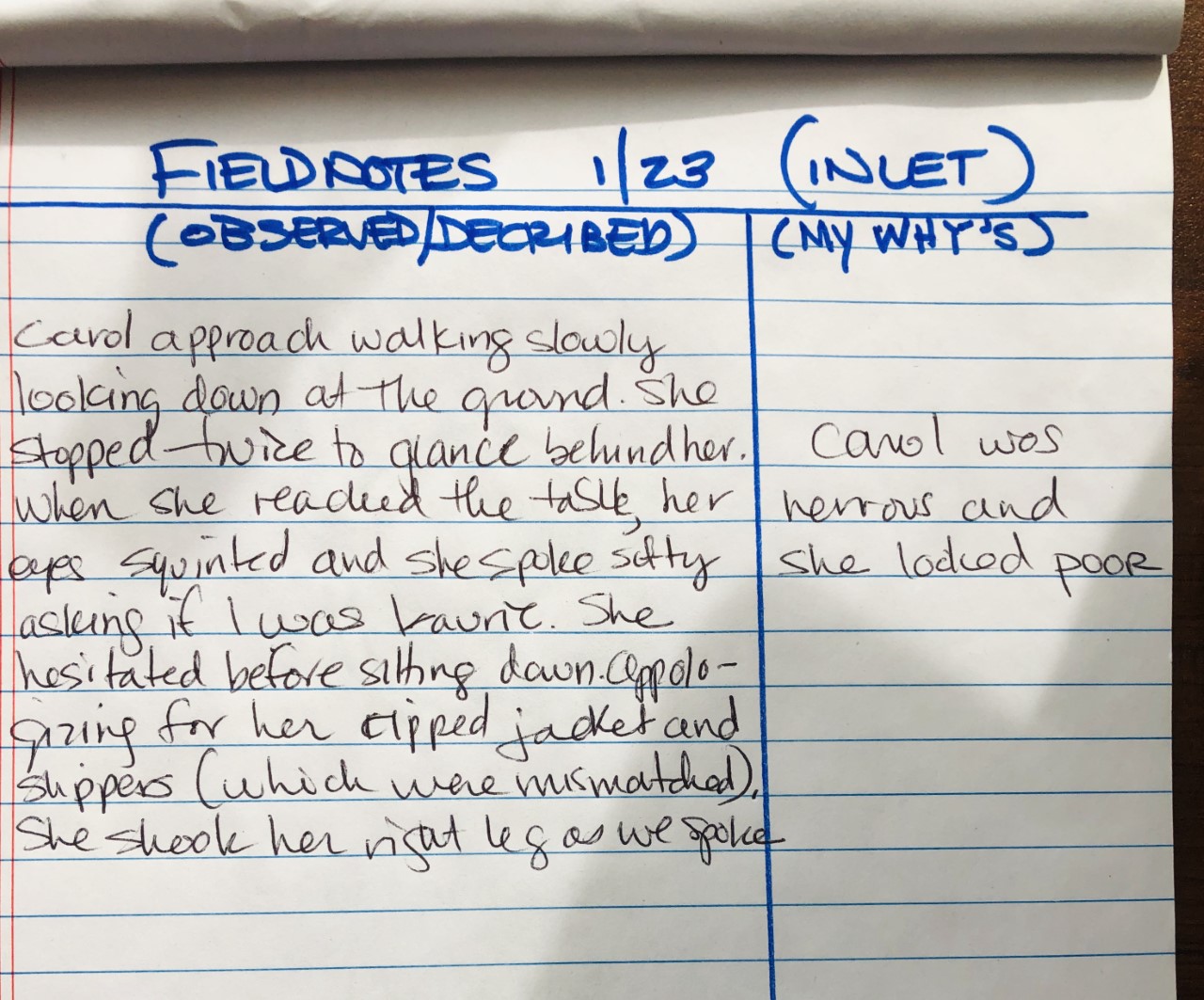
    Students need to make a distinction between what they OBSERVE and how they INTERPRET what they observe (keep them separate---the whats and the whys)

                                                                           Updated Notes

    How to do it:
    • be flexible, what you planned on taking notes on may be less interesting than what is in front of you
    • be sensitive to people 
      • include informants in jottings/interact
      • frame what you are doing in a positive and non intrusive way 
      • be selective about when to take notes
    • Ethics
      • ensure confidentiality (pseudonym or coding) and omit sensitive information
      • be upfront about what you are doing
    What to write
    • terse, evocative phrases
    • short quotes or phrases hat seem important (note time on recording)
    • maps and sketches
    • gestures, flavors, shouts, whispers, and all first impressions
    • distinguish between WHAT you saw and tasted and heard (objective) and HOW you interpreted these things (subjective).
    • do not impute MOTIVE (describe what you see and hear instead)
    • do not make guesses or judgments
    • describe observed behavior in as much detail as possible (don't use vague descriptions of mental states or attitudes).
                                                              More Notes

    Writing Up Your Fieldnotes
    • write up your notes ASAP so you do not forget things
    • headnotes (fill in the jottings)
    • keep a separate journal of your emotional responses (optional)
    Interviews

    • Session 1: get comfortable with each other and establish rapport
      • get comfortable
      • no right answers
      • answer questions and explain project
      • demonstrate a non-judgmental attitude and establish trust
    • Sessions which follow: subsequent sessions give informant a chance to reflect
      • do not read off a list of questions
      • avoid directed questions, let informant speak until they are finished
      • remember it is your interviewee's story (not the projects)
    • ethics:
      •  ensure anonymity that is important to informant
      • be prepared to leave out information which is damaging
    • Neutral Topic
      • start interviews with neutral (easy) topics
      • avoid ASSUMPTIONS and EXPECTATIONS
    • Cultural differences and miscommunication
      • Do not take the meaning of words, phrases or gestures for granted-even if you know them!
    • Process
      • develop rapport
        • apprehension (emphasize the importance of THEIR story)
        • explanation (restate what the informant says for confirmation)
        • cooperation (equal partners)
        • participation (interviewee as teacher)
      • Breaks in Interview
      • avoid leading questions
    Once you take your notes you will be able to distinguish between what you OBSERVE and what are your JUDGEMENTS. Your judgements should be kept out of your ethnographic account. Your descriptions will serve to allow the reader to draw conclusions, which is why your descriptions should be "THICK"(dense in description).

    QANON, Distrust of Biomedicine and Vaccine Conspiracies

      Distrust of vaccines may be almost as contagious as measles , More than 100 people have been infected with measles this year. Over 50 of t...